How to Use Trekking Poles: Techniques, Tips, and Terrain Adjustments
Author:sana
|
Released:February 6, 2026
Trekking poles can make hiking feel steadier, reduce strain on your legs, and improve your rhythm on long or uneven trails. Used well, they are not just extra gear in your hands; they are a practical tool for balance, support, and efficiency on everything from gentle paths to steep, slippery terrain.
Trekking Pole Benefits: Who Should Use Them and Why
Trekking poles are especially useful for beginners, hikers carrying heavier packs, and anyone who wants more stability on uneven ground. They are also helpful on steep, rocky, muddy, or slippery trails, where balance matters more and one bad step can quickly become a stumble or slide.
They are worth using if your knees, ankles, or shoulders complain on descents or long days. Poles can also help older hikers, people returning from injury, and anyone who simply feels more confident with an extra point of contact. The point is not that everyone needs them every time. It is that they are a smart choice when the trail asks more from your body than your legs alone should handle.
Trekking Pole Length Guide: How to Set the Right Fit
A good starting point is the 90-degree elbow rule on flat ground. Stand upright, plant the tips near your feet, and adjust the poles so your elbows sit at a right angle. That is the simplest and most reliable default for most hikers.
If the poles feel too long, your shoulders will rise and your arms will work harder than they should. If they feel too short, you will hunch forward and lose the support you wanted. Adjustable poles are the easiest choice because trail conditions change constantly, and one fixed length rarely works everywhere.
For a quick visual check, walk a few steps on level ground with relaxed shoulders and natural posture. The poles should feel like part of your stride, not like something you are actively fighting. If you want a deeper reference point, the key idea is that comfort and posture matter more than a perfect number.
Trekking Pole Technique: How to Walk With Poles Naturally
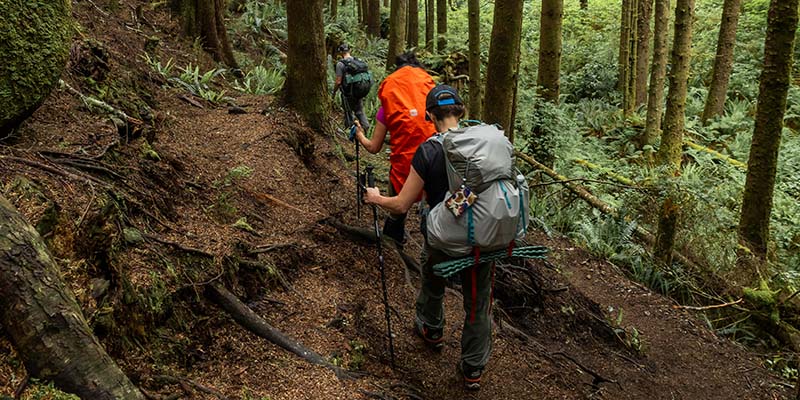
The most natural pattern is simple: move one pole with the opposite foot. Right pole with left foot, left pole with right foot. That rhythm keeps the motion smooth and helps the poles feel like part of walking, not like extra baggage in your hands.
Plant the poles slightly ahead of your body, at a mild angle, not straight down like a spear. Keep your arms relaxed and let the swing come from the shoulders, not from stiff elbows. If you are reaching far in front, you are probably overstriding with the poles and wasting energy instead of saving it.
On easy trails, you do not need to plant the poles hard or aggressively. A light, consistent pattern is usually better than dramatic pushing. The goal is efficiency, not force.
Trekking Pole Straps: How to Use Them Correctly
The strap matters more than many hikers think. Put your hand up through the strap from below, then grip the handle lightly so the strap carries much of the load. That setup reduces hand fatigue and keeps you from squeezing the grip the whole time.
A tight grip is one of the most common mistakes. It makes the forearms tired, stiffens the shoulders, and turns a helpful tool into something you fight against. The goal is a light hold, steady control, and a strap that shares the work.
The strap should not feel like an afterthought. Once it is fitted correctly, it helps distribute pressure and makes the poles feel more secure during longer descents or repetitive flat sections. If your hands keep tiring, the problem is often grip pressure or strap setup rather than the poles themselves.
Trekking Poles for Uphill, Downhill, and Traverses
On uphill sections, shorten the poles by about 5 to 10 cm so you can plant them without overreaching. That shorter setting gives you a better push angle and keeps the movement compact, which is especially helpful on steep grades. The poles should help with rhythm and propulsion, not pull you out of balance.
On downhill sections, lengthen the poles by about 5 to 10 cm so you can plant them farther ahead and use them more like controlled brakes. This helps reduce impact on the knees and keeps your center of gravity more stable when the ground drops away. On long descents, this small adjustment can make a surprisingly big difference.
Traverses need more judgment because one side of your body is uphill and the other is downhill. In that situation, adjusting each pole separately is often the best solution. The uphill pole is usually shorter and the downhill pole longer, so both arms stay comfortable and the tips still meet solid ground.
Trekking Poles on Different Terrain
On flat ground, keep a steady alternating rhythm and use the poles to support pace rather than force it. You do not need to drive them deep or plant them far ahead. A light, consistent touch is enough to improve balance and maintain a smooth tempo.
On climbs, plant the poles a little ahead and use them to help with propulsion. Think of them as a way to share the work between your arms and legs, not as a tool for pulling yourself uphill. They are especially helpful when the grade is long, the trail is slippery, or your pack feels heavier than usual.
On descents, the poles serve as stabilizers and brakes. By planting them slightly forward, you can absorb some of the shock that would otherwise go into your knees. This is one of the biggest advantages of trekking poles, especially on long downhill sections where fatigue makes your legs less precise.
On rocks, logs, mud, and puddles, use the poles as balance points and test the surface before committing your weight. A pole tip can tell you whether ground is firm, loose, or slick. On stream crossings, plant carefully and do not rush the first step; one unstable pole can throw off your balance more than you expect.
Advanced Trekking Pole Patterns for Steeper Trails
The standard alternating pattern works well for most hikers and most terrain. It is the first technique to learn because it feels natural and remains efficient even when the trail changes gradually. Once that rhythm becomes automatic, you can switch techniques when the terrain demands more support.
For steeper sections, a double-plant pattern can be useful. In this method, both poles go down together, then you step through. It creates a more deliberate rhythm and can provide a stronger sense of security on steep climbs or descents.
A same-side support pattern is another option when one leg needs a break or when the terrain makes the usual rhythm awkward. There is no rule that says you must use one pattern all day. The best hikers adjust their pole work to match the trail instead of forcing one motion everywhere.

Common Trekking Pole Mistakes to Avoid
- Using poles that are set too long or too short
The biggest mistake is incorrect pole length. It affects posture, balance, shoulder tension, and energy use all at once. If the poles feel awkward, length is the first thing to check.
- Locking your elbows or keeping your arms too rigid
This makes hiking feel mechanical and tiring. Poles should support a natural walking motion, not restrict it.
- Gripping too tightly and planting poles too far ahead
Both habits waste energy and can make your upper body sore before your legs do.
- Letting poles act like dead weight
Poles work best when you place them actively, load them briefly, and keep moving. They should assist your movement, not just hang in your hands.
- Sticking to one setup and rhythm
Trail conditions change, and your technique should adapt with them. The more flexible you are, the more useful your poles become.
Trekking Pole Practice Tips for Better Rhythm
If trekking poles feel awkward at first, that is normal. The rhythm usually becomes smoother after a few hikes, especially if you start on easy trails and give yourself time to adapt. Stairs, park paths, and mild hills are good places to practice before using poles on longer or rougher routes.
Keep your shoulders loose and let your arms swing naturally. If your upper body feels tense, reduce your grip pressure and check the strap position. Most of the time, comfort improves once you stop trying to control every movement so tightly.
It also helps to think of the poles as part of your walking system rather than separate tools. When they are integrated into your stride, they feel less like equipment and more like support. That mindset alone often makes the technique easier.
Pay attention to how your body responds over time. If your knees feel better on descents, your shoulders stay relaxed, and your balance improves on rough ground, the technique is working. If not, the fix is usually small: a different length, a lighter grip, or a slower, more natural rhythm.
Trekking Poles vs Hiking Staffs: Which Is Better?
Trekking poles and hiking staffs both help with balance, but they do so in different ways. Poles give you two points of support and a more symmetrical feel, which is why they are usually better for rough, steep, or technical terrain. A staff is simpler, one-handed, and can feel more relaxed on easy walks.
A hiking staff may suit someone who wants less gear in motion or prefers a traditional feel. It can be useful for casual outings, lighter trails, or situations where one free hand is convenient. For many hikers, though, poles offer better support because they distribute effort more evenly between both sides of the body.
If joint relief, heavy packs, or challenging terrain are priorities, poles are usually the stronger choice. If simplicity matters most, a staff may be enough. The best option depends less on tradition and more on the trail in front of you.
Trekking Pole Final Tips for Safer, Easier Hiking
The best trekking pole technique is usually the least dramatic one. Keep the elbows soft, let the straps do part of the work, and place the tips close to your natural stride. Then adjust for uphill, downhill, and uneven ground instead of forcing one method everywhere.
A good pair of poles should make hiking feel calmer, not more complicated. They should help you stay balanced, reduce strain, and keep your pace steady when the trail becomes unpredictable. When used well, they do not distract from the hike; they make the hike easier to enjoy.
Start on simple trails, tune the length, and pay attention to how your body feels. As you gain experience, the technique becomes more automatic and the benefits become more obvious. Trekking poles work best when they feel like an extension of your movement, not a separate task to manage.
Related Posts
Outdoor Gear
How to Choose the Best Camping Stove for Backpacking
Outdoor Gear
Best Insulated Outerwear for Cold Weather and Outdoor Use
Outdoor Gear
The Best Headlamps for Brightness, Comfort, and Battery Life
Outdoor Gear
Hiking Sock Materials Compared: Merino Wool Vs Synthetic Blends
Outdoor Gear
Waterproof Hiking Boots With Latest Tech (2026 Picks)
Guides and Tips